%20(1).webp)
THE HISTORY OF THE JET ENGINE: Early Experiments to Modern Engineering
For more than two thousand years, humans have been fascinated by the idea of propulsion. Long before modern aircraft existed, inventors were already experimenting with the forces that would eventually power some of the fastest machines ever built.
One of the earliest recorded examples appeared around 150 B.C. with the invention of the Aeolipile by Hero of Alexandria. Often called “Hero’s Engine,” the device used steam escaping through curved nozzles to spin a metal sphere at high speed. While primitive, it demonstrated a principle that would later become fundamental to jet propulsion: thrust generated through rapidly expelled gas.
.webp)
At the time, the Aeolipile was viewed as a scientific curiosity rather than a practical machine. No one yet understood how transformative controlled propulsion would become. Still, the idea survived. Across centuries of experimentation, engineering, and failed inventions, the foundations of the modern jet engine slowly began to take shape.
Early Flight Experiments and Propulsion Concepts
The desire to achieve powered flight existed long before the modern aviation era. Ancient Greek philosopher and mathematician Archytas reportedly created a wooden bird propelled by compressed air or steam, making it one of the earliest known attempts at self-propelled flight.
Centuries later, in 1633, Ottoman inventor Lagari Hasan Çelebi is said to have launched himself skyward using a cone-shaped rocket before gliding back to earth with wing-like structures attached to his body. While historians debate the exact details, the story reflects humanity’s growing obsession with controlled aerial movement.
By the early twentieth century, propulsion systems became increasingly sophisticated. Engineers across Europe began experimenting with pulsejets, gas turbines, and compressed-air systems capable of producing continuous thrust.
In 1906, Russian engineer V.V. Karavodin patented one of the first pulsejet engine designs. Although early systems were inefficient and mechanically unreliable, each invention pushed aerospace engineering closer to practical jet-powered flight.
The Birth of the Modern Jet Engine
The true breakthrough arrived with the development of the gas turbine engine.
Unlike piston engines, gas turbines continuously compress incoming air, mix it with fuel, ignite the mixture, and expel high-speed exhaust gases to generate thrust. This concept became the foundation of virtually every modern jet engine used today.
In 1903, Norwegian engineer Ægidius Elling successfully built one of the first gas turbines capable of sustained operation. However, the engineering materials available at the time could not withstand the extreme temperatures required for practical aviation use.
The next major leap came in 1921 when French engineer Maxime Guillaume patented an aircraft gas turbine engine concept remarkably similar to future turbojet designs. Although his ideas were ahead of their time, the technology required to manufacture them still did not exist.
Everything changed in the 1930s.
British engineer Sir Frank Whittle patented one of the world’s first practical turbojet engine designs in 1930. His revolutionary concept demonstrated that jet propulsion could realistically power aircraft at speeds and altitudes impossible for conventional piston engines.
By 1937, Whittle had successfully tested a functioning turbojet prototype.
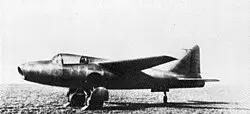
At nearly the same time, German engineer Hans von Ohain independently developed a similar engine design in Germany. His work led to the Heinkel He 178 becoming the first turbojet-powered aircraft to successfully complete a flight in 1939.
The jet age had officially begun.
Jet Engines During World War II
World War II accelerated jet engine development at an extraordinary pace.
Germany introduced the Messerschmitt Me 262, widely recognized as the world’s first operational jet-powered fighter aircraft. Faster than any Allied piston aircraft at the time, it demonstrated the enormous military potential of turbojet propulsion.
Both Allied and Axis engineers rapidly improved engine efficiency, thrust output, and reliability throughout the war. By the end of the conflict, jet propulsion had evolved from an experimental technology into the future of military aviation.
After the war, Allied nations studied captured German aircraft and engine technology extensively. These discoveries helped fuel rapid advancements in the United States, the United Kingdom, and the Soviet Union during the postwar aviation boom.
The Rise of Commercial Jet Aviation
By the 1950s, jet engines were becoming standard in military aircraft around the world. Commercial aviation soon followed.
Early passenger aircraft such as the de Havilland Comet and later the Boeing 707 transformed long-distance travel forever. Flights that once required days could suddenly be completed in hours.
The introduction of high-bypass turbofan engines during the 1960s and 1970s dramatically improved fuel efficiency, noise reduction, reliability, and passenger comfort. These innovations made modern air travel economically viable on a global scale.
Today, commercial jet engines are among the most sophisticated machines ever engineered. Modern turbofan engines contain thousands of precision-manufactured components capable of operating under extreme heat, pressure, and rotational forces for thousands of hours at a time.
Engineering Innovations That Changed Aviation
The evolution of jet engines depended on major advances in both aerodynamics and materials science.
Axial-flow compressors allowed engineers to dramatically improve airflow efficiency while reducing engine size and drag. Advanced turbine blade designs enabled engines to operate at increasingly higher temperatures and rotational speeds.
At the same time, breakthroughs in metallurgy introduced high-performance materials such as titanium alloys, nickel superalloys, and heat-resistant composites capable of surviving conditions that would destroy ordinary metals.
These engineering innovations pushed aviation into an entirely new era of performance.
Jet engines became symbols of speed, precision, and mechanical excellence.
The Influence of Jet Engine Design Beyond Aviation
The visual and mechanical beauty of jet engines extends far beyond aerospace engineering.
Their exposed turbine structures, polished metallic finishes, and intricate internal geometry have inspired designers across architecture, automotive engineering, horology, and luxury manufacturing.
Modern jet engines represent more than transportation technology. They embody craftsmanship, power, innovation, and human ambition.
That influence can now be seen in an unexpected industry: luxury espresso machines.
Jet Engine Inspired Espresso Machines
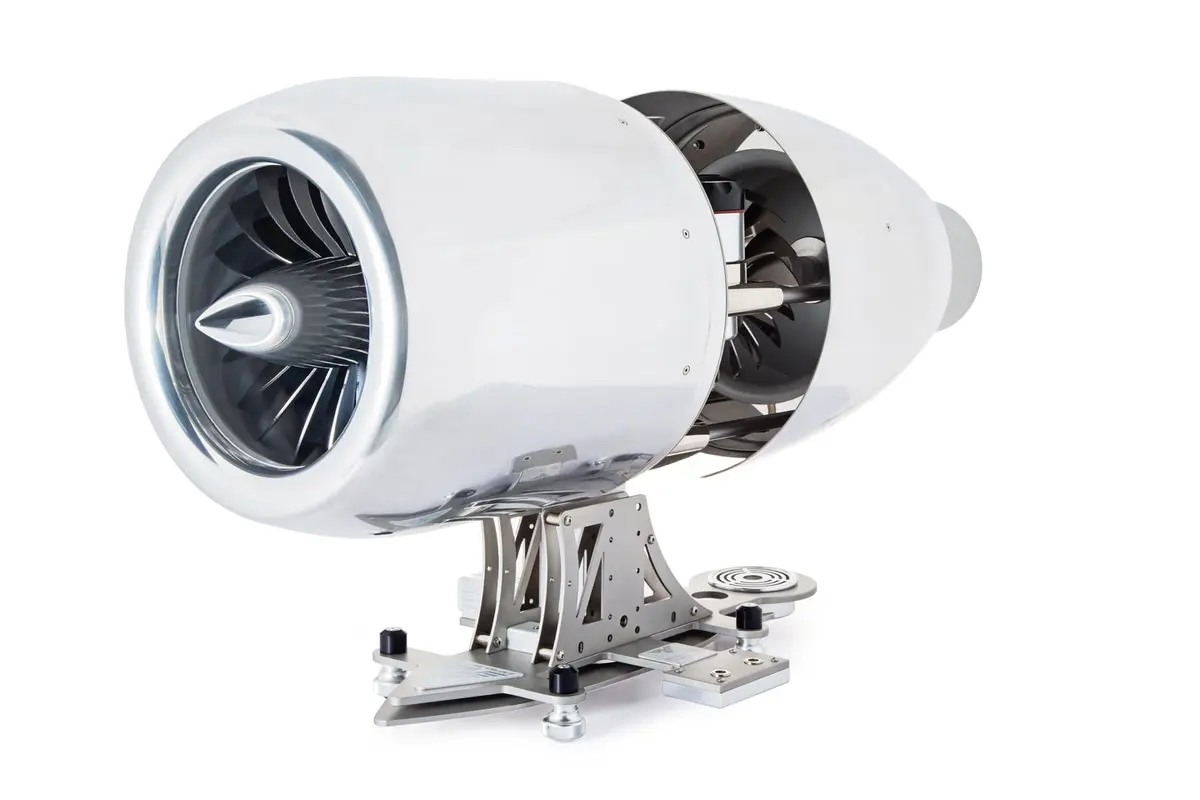
The engineering legacy of aviation directly inspired the creation of jet engine inspired espresso machines such as the Aviatore Veloce collection.
Designed as quarter-scale interpretations of real jet engine concepts, these handcrafted machines combine aerospace aesthetics with precision espresso engineering. Materials commonly associated with aviation, including titanium, surgical stainless steel, and aluminum alloys, are used throughout their construction.
Every component is carefully engineered to reflect the structure and visual identity of real turbine engines while maintaining high-performance brewing functionality.
Rather than functioning as ordinary kitchen appliances, these machines exist as mechanical artworks that celebrate the history of aerospace innovation and industrial design.
They capture the same fascination that has surrounded jet propulsion for generations: the pursuit of speed, precision, and engineering perfection.
From Jet Propulsion to Functional Mechanical Art
Few inventions have transformed the modern world as dramatically as the jet engine.
What began as ancient experiments with steam and propulsion eventually reshaped aviation, global travel, military engineering, and modern industrial design. Today, the influence of jet engines continues far beyond the runway.
In the world of luxury espresso machines, aerospace-inspired engineering represents the fusion of craftsmanship, mechanical artistry, and functional performance.
By combining advanced materials, precision manufacturing, and iconic turbine-inspired design, companies such as Super Veloce continue to celebrate the innovation that defined the jet age.
These machines stand as tributes to one of humanity’s greatest engineering achievements: the jet engine.